

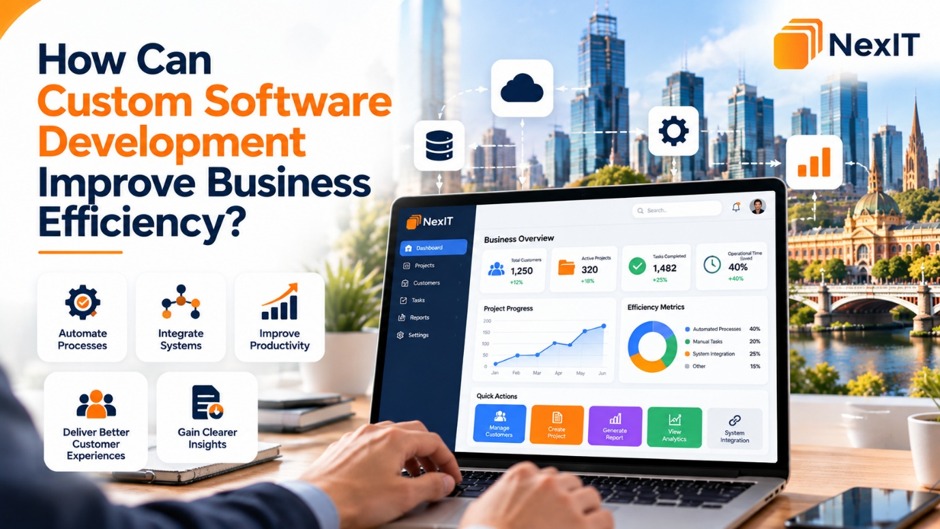
Running a business involves more than serving customers. Teams also manage enquiries, update records, prepare reports, track projects and coordinate information across different systems. When these tasks rely on spreadsheets, emails and repetitive data entry, valuable time can disappear into administration.
Custom software development can help Melbourne businesses simplify these processes by creating digital tools around the way their teams actually work. Instead of forcing employees to adapt to a generic platform, a tailored solution can automate routine tasks, connect existing systems and make important information easier to access.
The goal is not simply to introduce new technology. It is to help people work more efficiently, reduce avoidable errors and give the business room to grow.
What Is Custom Software Development?
Custom software is designed to address the specific requirements of a business. It might be an internal management system, a customer portal, a booking platform, a reporting dashboard or an application that connects several existing tools.
For example, a Melbourne construction company may need a better way to coordinate job schedules, site updates and client communications. A professional services firm might benefit from a system that manages enquiries, documents and project milestones in one place.
The right solution depends on the problem being solved. Good software development starts by understanding the workflow, identifying bottlenecks and deciding which improvements will deliver genuine value.
1. Automate Repetitive Business Tasks
Manual administration can consume hours that employees could spend on more valuable work. Copying customer details between systems, sending routine updates, preparing invoices and compiling reports are common examples.
Custom software can automate suitable tasks and establish consistent workflows. For instance, a new customer enquiry could create a record, notify the relevant team member and trigger a follow-up task automatically.
This can reduce duplicate data entry, minimise avoidable mistakes and help employees focus on customer service and business development.
Automation should be applied thoughtfully. Processes that are unclear or constantly changing may need improvement before they are automated.
2. Connect Disconnected Systems
Many businesses use separate tools for accounting, customer relationship management, inventory, scheduling and project management. If those tools do not share information effectively, staff may have to enter the same details multiple times.
Tailored software and system integrations can help information move between compatible platforms. A central dashboard, for example, could bring together relevant sales, project and operational information without requiring staff to check several separate applications.
For Melbourne businesses managing multiple teams, suppliers or locations, this can make handovers smoother and reduce confusion about which information is current.
Importantly, a complete replacement is not always necessary. Sometimes, integrating existing software or building a focused application is more practical than starting from scratch.
3. Improve Reporting and Decision-Making
Business decisions are easier when information is accurate, organised and available at the right time. Yet important data can become scattered across spreadsheets, email threads and separate applications.
Custom reporting tools can bring relevant information together and present it through dashboards, summaries or automated reports. Managers may gain a clearer view of project progress, customer enquiries, workload and operational performance.
Better visibility can help teams identify delays earlier, allocate resources more effectively and respond to problems before they become larger issues.
The value comes from tracking useful measures, not collecting data for its own sake. A well-designed system should make the information people need easier to understand and act on.
4. Create a Better Customer Experience
Efficiency also affects customers. Slow responses, repeated requests for information and unclear communication can make a business harder to deal with.
Depending on its needs, a business could use custom software to offer online bookings, customer portals, order tracking or faster enquiry management. Customers may be able to access relevant information themselves, while staff spend less time answering routine questions.
For service providers across Melbourne, a smoother digital experience can support stronger customer relationships and help the team manage demand as the business grows.
When Should a Melbourne Business Invest in Custom Software?
Custom development may be worth exploring when employees regularly work around the limitations of existing tools, important processes depend on manual spreadsheets, or separate systems create repeated errors and delays.
However, custom software is not always the best option. Established products often work well for standard needs such as accounting, payroll and email. Before investing in a new build, compare configuration, integration and custom development options.
Consider the full cost over time, including implementation, subscriptions, maintenance, support and staff hours spent on workarounds. A smaller, staged project can also help validate the benefits before committing to a larger system.
How to Choose a Software Development Company in Melbourne
Look for a development partner that takes time to understand your business before recommending a solution. Ask how they gather requirements, plan integrations, test software, protect data and provide ongoing support.
A reliable partner should explain the expected scope, risks, ownership arrangements and maintenance costs in clear language. They should also help define measurable goals, such as reducing processing time or improving reporting accuracy.
Choosing suitable software development services in Melbourne is about more than technical skills. It means finding a team that can connect the technology to practical business outcomes.
Talk to a NexIT Expert
New Enquiries: 1300 899 259 | Support Team: [email protected]
REQUEST A FREE CONSULTATION