
A few years ago, a customer looking for a service typed a few words into Google and scanned the list of links.
Now they might ask a full question instead: “Who’s a reliable electrician near Campbellfield who does emergency call-outs?” or “What should I look for in a software company in Melbourne?” And the answer may come back as a written summary, with a handful of businesses mentioned, before they click anything.
That shift is what people mean by AI search. If your business isn’t one of the names that appears, you can lose the customer before they ever reach your website.
The good news is that preparing for it doesn’t require a new strategy or a bag of tricks. It mostly means doing the fundamentals well and making your business easy to understand, trust and recommend.
What is AI search?
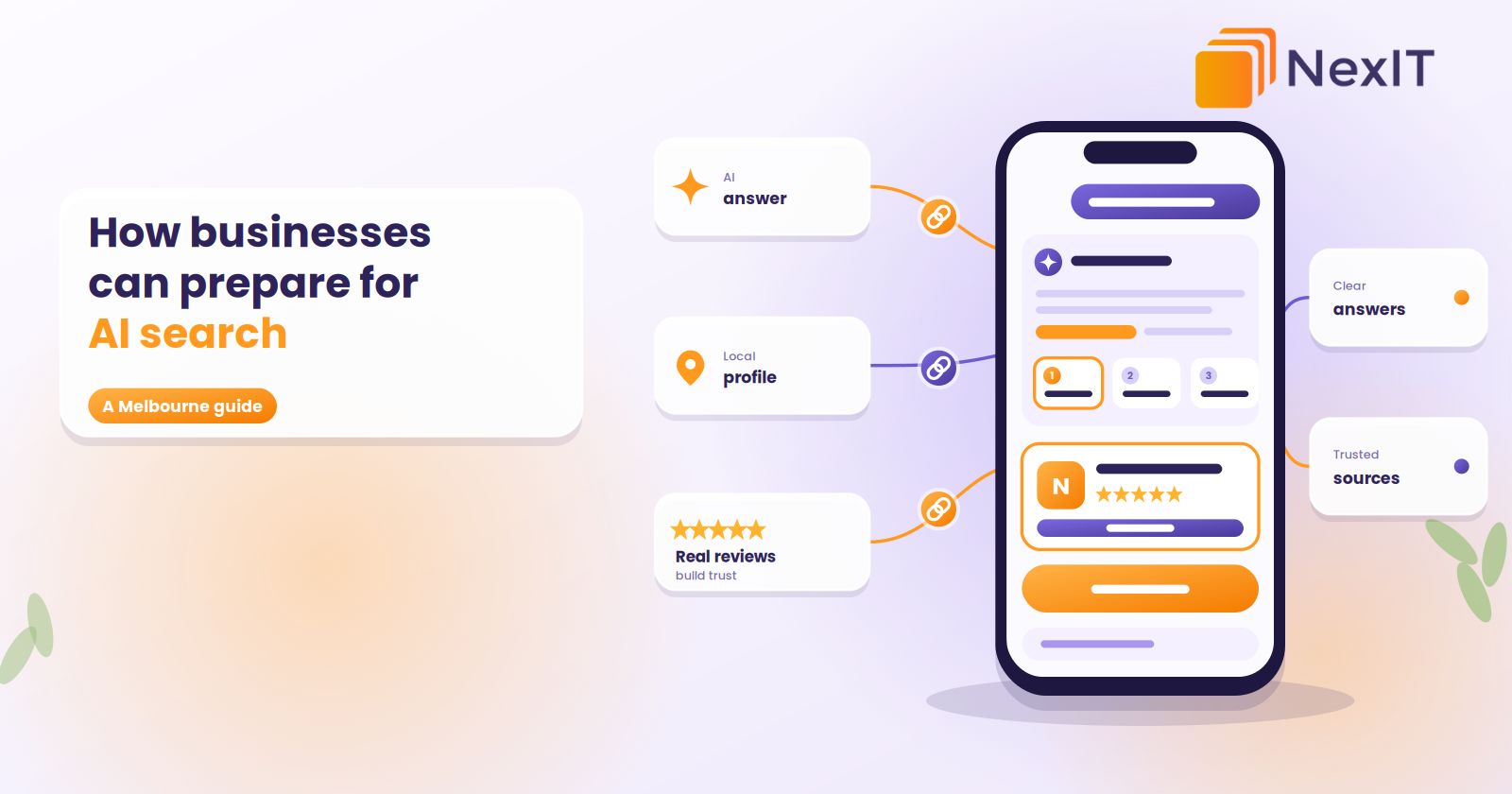
AI search covers any search experience where an AI system reads information from across the web and builds an answer, instead of only listing links. The main ones are:
- Google AI Overviews and AI Mode, which show AI-generated summaries and conversational answers inside Google
- ChatGPT search, where people ask questions and get answers with sources
- Perplexity, an AI answer engine that cites its sources
- Microsoft Copilot and Gemini, which pull in web results when answering
These tools look different, but they behave in a similar way. They favour content that’s clear, credible and easy to extract an answer from, and they often draw on the same sources Google already trusts.
What hasn’t changed, and what has
Here’s the part that cuts through the noise.
What hasn’t changed: Google has said that a page generally needs to be indexed and eligible to appear in normal Google Search to be used as a supporting link in AI Overviews or AI Mode. There’s no separate technical checklist, and no special markup you must add. Traditional SEO still matters, because it’s the foundation.
What has changed: people ask longer, more conversational questions. Answers often appear before a click. And AI systems summarise information from several sources, so your business needs to be mentioned and described accurately, not just ranked.
In other words, the old goal was “rank high”. The new goal is “be the clear, trusted answer.”
9 practical ways to prepare
1. Make sure AI systems can actually reach your site
If a crawler can’t read your content, it can’t use it. Check that:
- Your important pages are indexed in Google
- Your robots.txt file or firewall isn’t accidentally blocking search or AI crawlers
- Key content isn’t hidden behind scripts that crawlers can’t follow
- Your site loads quickly and works well on mobile
- Pages have sensible titles, clean URLs and no duplicate versions competing with each other
This is plain technical SEO, and it’s where many businesses quietly lose ground.
2. Answer real questions, clearly and early
AI systems pull answers from pages that state them plainly. So write the way people ask.
- Use headings that match real questions, such as “How much does X cost in Melbourne?”
- Put the direct answer in the first sentence or two, then explain
- Keep paragraphs short and focused
- Add a genuine FAQ section for common questions
This helps AI systems and human readers equally. Nobody enjoys scrolling through five paragraphs to find the answer.
3. Show real experience, not generic content
Generic articles are exactly what AI can produce for itself, so they add little. What it can’t produce is your actual experience.
Include things that only your business can offer:
- Case studies and real project examples
- Photos, results and testimonials
- Local knowledge, such as suburbs you serve and problems common to your area
- Named authors or team members with relevant experience
- Honest opinions, including when your service isn’t the right fit
These signals of experience and trust matter to Google’s quality systems and make your content worth citing.
4. Get your local basics right
Many AI answers about local services draw on business listings, maps and reviews. If someone asks for a recommendation near them, these are often the sources.
- Claim and fully complete your Google Business Profile
- Keep your business name, address and phone number consistent everywhere
- List accurate services, hours and service areas
- Ask satisfied customers for genuine reviews regularly, and reply to them
- Add real photos
For a suburb like Campbellfield, where industrial, trade and local retail businesses all compete for similar searches, strong local signals can be the difference between being named and being skipped.
5. Build your reputation beyond your own website
AI systems don’t rely only on what you say about yourself. They look for confirmation elsewhere.
That means mentions and listings on credible sites: industry associations, local business directories, supplier and partner pages, local news and reputable review platforms. Being described the same way in several trusted places makes you easier to recommend.
6. Use structured data sensibly
Structured data, or schema markup, helps search engines understand what a page is about, such as your business details, services or reviews. It’s worth adding the basics, like organisation and local business information.
Just be realistic. It isn’t a switch that guarantees AI visibility, and there’s no special “AI schema.” Treat it as housekeeping, not a hack.
7. Keep key pages current
AI systems tend to favour fresh, reliable information. Review your important pages regularly. Update pricing guidance, services, dates, team details and examples, and remove anything outdated. A page that was accurate three years ago may now be misleading.
8. Make it easy to act once someone arrives
People who reach your site after an AI summary have often done much of their research already. They arrive more ready to act.
Make that moment easy:
- Show your phone number and a click-to-call button
- Use a simple, visible enquiry form
- State what you do, where you work and how to get started
- Make sure the page loads fast on a phone
If someone is ready to contact you and has to hunt for how, you’ve wasted the visit.
9. Measure what’s happening
You can’t improve what you don’t track. Useful steps include:
- Search Console: keep an eye on impressions, clicks and the pages that perform. Google has announced new reporting for generative AI visibility, rolling out gradually, so check whether your account has it.
- Analytics: look for traffic referred from AI tools such as ChatGPT and Perplexity.
- Manual testing: once a month, ask five questions your customers might ask on Google, ChatGPT and Perplexity, and note whether you appear and how you’re described.
- Business results: track enquiries, calls and branded searches, not just rankings.
Talk to Expert for More Information
New Enquiries: 1300 899 259 | Support Team: [email protected]
REQUEST A FREE CONSULTATION
What to avoid
- Chasing shortcuts. Anyone selling a secret trick to “rank in ChatGPT” is guessing.
- Mass-producing AI-written articles. Thin, generic content doesn’t earn trust.
- Creating separate pages just for AI. Build useful content for people and it works across search experiences.
- Keyword stuffing. It reads badly and no longer works.
- Ignoring traditional SEO. It’s still the base that AI search builds on.
- Blocking crawlers by mistake. Check your settings before assuming there’s a bigger problem.
A simple 30-day plan
Week 1: check the foundations. Confirm your key pages are indexed, check robots.txt and site speed, and test the site on a phone.
Week 2: fix your local profile. Update your Google Business Profile, check listings for consistency and request reviews from recent customers.
Week 3: improve your best pages. Rewrite headings as questions, add direct answers at the top, add an FAQ and include real examples or case studies.
Week 4: test and measure. Ask your five questions on Google, ChatGPT and Perplexity. Record what you find, set up tracking and decide what to improve next.
Repeat the testing monthly. Small, steady improvements add up.
How to choose the right partner
Look for a team that:
- Asks about your goals and users before quoting
- Can show experience with both websites and web applications
- Explains the trade-offs in plain language
- Is honest if a simpler solution would work
- Clarifies ownership of the code, design and data
- Offers ongoing support after launch
A good provider will tell you if you don’t need the bigger build.
Talk to NexIT Solutions
What is AI search?
AI search is when a search tool uses artificial intelligence to read information from many sources and give a direct, written answer, instead of only listing links. Examples include Google AI Overviews, AI Mode, ChatGPT search and Perplexity.
Does SEO still matter with AI search?
Yes. Google says pages need to be indexed and eligible for normal search to appear as supporting links in its AI features, and AI tools tend to draw on content that already performs well. Strong SEO remains the foundation, with clear answers and credibility layered on top.
How do I get my business to appear in AI answers?
There’s no guaranteed method, but you can improve your chances. Keep your site crawlable and fast, answer real questions clearly, show genuine experience, maintain an accurate Google Business Profile with good reviews, and earn mentions from credible local and industry sites.
Do I need special schema or separate pages for AI search?
No. There’s no special markup or separate page type required. Standard structured data can help search engines understand your content, but it isn’t a shortcut. Focus on helpful content that serves people.
How can I track whether AI tools mention my business?
Test regularly by asking the questions your customers ask on Google, ChatGPT and Perplexity, and note whether your business appears. Also check Search Console, including any generative AI reports available to your account, and look for AI-referred visits in your analytics.
Not sure which is right for your business?
The best choice depends on what your website needs to do for you, and a short conversation usually makes it clear. NexIT Solutions helps Melbourne businesses plan, design and build websites on WordPress, custom platforms and everything in between, and we’ll tell you honestly which one fits.
📞 Call NexIT Solutions today: 1300 899 259