

When planning an online presence, should your business choose a website or a web app? The right choice depends on what customers or staff need to do, your budget and your long-term plans.
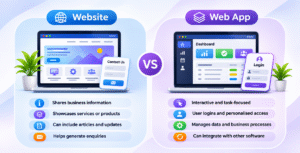
A website mainly shares information and attracts enquiries. A web app helps users complete tasks, manage information or follow a process.
What is the difference between a website and a web app?
A website is a collection of pages people browse. It may include service details, galleries, articles and contact forms. Its main purpose is to explain what your business offers and help visitors get in touch.
A web app is an interactive online tool. Examples include appointment booking, order management, job tracking, customer accounts and document submission. Users may sign in to access role-specific features.
There can be overlap, but the main distinction is simple: a website presents information, while a web app helps people complete tasks.
When is a website the better choice?
A traditional website may be enough if your goals are to build credibility, explain your services and generate enquiries. It is often suitable when you want to:
Showcase products, services or projects.
Publish articles and business updates.
Help customers find contact details.
Receive enquiries and improve search visibility.
For many small businesses, a well-planned website is a practical starting point. Prioritise clear content, mobile-friendly layouts, fast-loading pages and simple navigation.
When does a web app make more sense?
Consider a web app when customers or staff need to do more than read information. If people regularly log in, submit requests, manage records or follow multi-step processes, an interactive platform may make things easier.
For example, customers could book appointments, upload documents and check request progress. Staff could assign jobs, update statuses and access information in one place instead of relying on spreadsheets.
web app development services Somerton can help turn repeated manual processes into structured online experiences. The goal is to solve a genuine problem, not add features simply because the technology allows it.
What should you consider before choosing?
Map the tasks users need to complete and identify where people lose time, repeat information or need staff assistance. Then ask:
Who will use the platform: customers, employees or suppliers?
Do users need different access permissions?
What information must they view or update?
Does it need to connect with existing software?
Which tasks should be automated?
Keep the first version focused. A smaller set of useful features is often easier to test, launch and improve than a large platform with unproven functions.
Compare costs, maintenance and future growth
A website with standard pages and basic enquiry features is generally simpler to build. A web app may need accounts, databases, custom workflows, integrations, security controls and more testing. These requirements can increase the initial investment and ongoing maintenance.
Look beyond the build price. Consider hosting, licences, support, updates, backups and security reviews. For web application development Somerton, ask for a breakdown of features, integrations, testing and ongoing support. A clear scope makes proposals easier to compare.
How should you plan the project?
Write down the essential user journeys before discussing screens or technology. Decide what must be ready at launch and what can wait. This gives the development team a practical scope to estimate.
When assessing web app development services Somerton, choose a team that asks about your processes, users, data and priorities before recommending a solution. Clarify how progress, changes and testing will be managed.
What happens after launch?
Both options need ongoing attention. A website may need content updates, software patches, backups and performance checks. A web app may also need user support, access management and workflow improvements.
For web application development Somerton, discuss maintenance and support before the project begins. Plan who will manage updates and how users can report problems as your business changes.
Conclusion
A website helps people understand your business, while a web app helps them interact with it and complete tasks. Neither is automatically better. Choose the option that fits your users, solves a genuine problem and can be supported over time.
If you are weighing up the options, NexIT Solutions can help you define your requirements and plan a practical approach for your Somerton business.
Talk to a NexIT Expert
New Enquiries: 1300 899 259 | Support Team: [email protected]
REQUEST A FREE CONSULTATION