
It’s Monday, 7.30am. The phone is already ringing. Three emails have arrived overnight with orders in different formats. A text message from a regular customer says “same as last week plus 10 of the blue ones.” Someone on your team is hunting through a spreadsheet to check what that customer’s price is.
Sound familiar? Most wholesalers and distributors run on a mix of phone calls, emails, texts and memory. It works, until volume grows or the person who “just knows” the pricing takes a holiday.
A customer portal is the usual answer, and it’s a good one in the right situation. But it’s also a real investment, so this guide covers what a portal does, when it pays off and when you’re better off without one.
What is a customer portal, and how is it different from an online shop?
The best portals handle the things your team currently does manually.
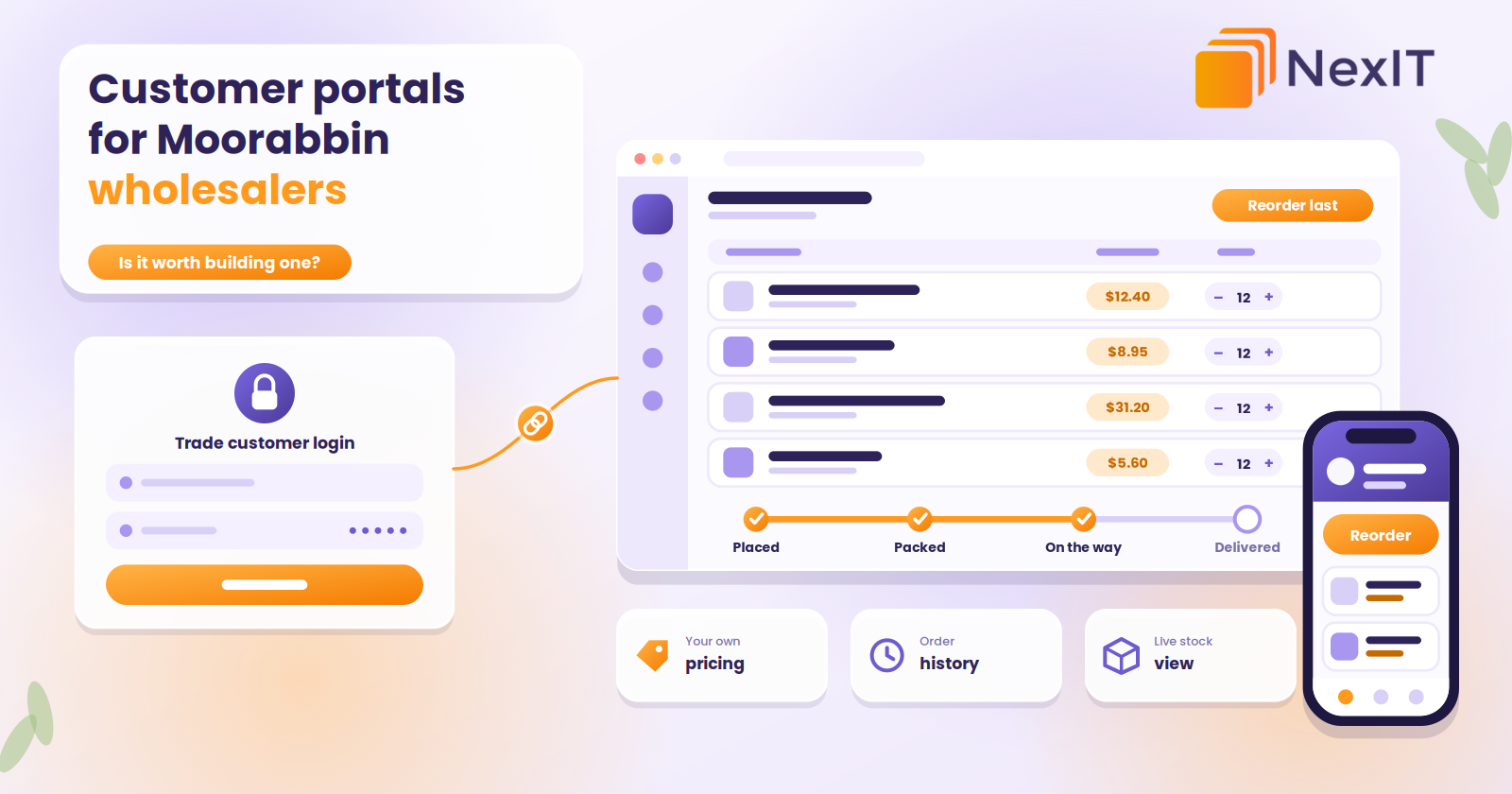
For ordering
- Customer-specific pricing, volume breaks and contract rates
- Customer-specific catalogues, so people only see what they can buy
- Reordering from past orders and saved lists
- Quick order forms, where customers type product codes or upload a list
- Purchase order numbers and delivery instructions
- Approval steps for larger orders
For information
- Live or near-live stock availability
- Order status and delivery tracking
- Invoices, statements and payment history
- Product documents such as specification sheets, certificates and safety data sheets
For your team
- Orders that arrive complete and in a consistent format
- Fewer calls asking “where’s my order?” or “what’s my price?”
- Automatic notifications, such as back-order alerts and dispatch emails
- Sales reports by customer, product and rep
Is it worth it? A realistic business case
The honest way to answer is with your own numbers. Here’s a simple, illustrative example.
Say your team handles 30 phone and email orders a day, and each takes about six minutes to enter and check. That’s roughly three hours a day, or about 15 hours a week. At an average loaded cost of $45 an hour, that’s around $675 a week, or about $35,000 a year, spent on typing.
If a portal takes even half of those orders off your team, it frees up around $17,000 a year in time. That’s before counting fewer errors, fewer credit notes, faster payment and the orders you win because ordering is easier.
This is an example, not a guarantee. Your numbers will differ. But run the same calculation for your own business before you decide, because it tells you what a portal needs to deliver to pay for itself.
The benefits that don’t show up neatly in a spreadsheet matter too:
- Orders outside business hours. Trade customers often order early in the morning, in the evening or on weekends.
- Fewer mistakes. Customers pick the exact product code instead of describing it.
- Better customer relationships. Your reps spend time advising and selling, not typing.
- Data. You can see what customers buy and when they stop, so you can act sooner.
When a portal is not the right answer
Be wary of anyone who says every wholesaler needs one. Hold off if:
- You have very few customers. A shared order form or a good email process may do the job.
- Every order is custom. If each one needs negotiation, a portal adds little.
- Your product and price data is a mess. A portal exposes data problems. Clean the data first.
- Your customers won’t use it. Ask a few key customers before you build. Some prefer calling their rep.
- Your underlying process is broken. A portal speeds up whatever you give it, including bad habits.
Sometimes the better first step is smaller: a tidy price list, a standard order form, or an automated email confirmation for orders. Our guide to business automation in Moorabbin covers those quick wins.
What this looks like for Moorabbin wholesalers
Moorabbin’s industrial east, the Moorabbin Airport precinct and the surrounding areas of Cheltenham, Braeside, Heatherton and Clayton South are home to wholesalers, distributors, manufacturers and suppliers serving trades, retailers and businesses across Melbourne’s south-east.
A few factors are worth thinking about locally:
- Your customers are often busy tradies and small businesses. The portal must work well on a phone, with big buttons and fast reorder.
- Accounting integration matters. Many Australian businesses use MYOB, Xero or QuickBooks, so your portal should sync with them to avoid double entry.
- GST and account terms need to be right. Invoices, statements and credit limits should follow your existing process.
- Delivery and pick-up options vary. Customers might collect from your warehouse or want scheduled delivery, and the portal should handle both.
- Orders arrive outside office hours. A portal lets customers order at 6am or 9pm without needing your team online.
What it looks like in practice
Take a typical small trade or distribution business. A customer fills in a quote form. Without automation, someone reads it, copies the details into a spreadsheet, writes a quote, emails it, then remembers (or forgets) to follow up in three days.
With automation, the form creates a customer record, notifies the right person with the details, drafts the quote from a template for review, sends it, and follows up automatically if there’s no response. The human still makes the decisions. The system handles the copying, reminding and chasing.
Time savings vary, but removing even an hour a day of repetitive work from several staff frees a lot of capacity over a year.
Talk to a NexIT Expert
New Enquiries: 1300 899 259 | Support Team: [email protected]
REQUEST A FREE CONSULTATION
What does it cost?
Costs vary widely. The main factors are:
- The number of features and customer types
- Complexity of pricing and approval rules
- Integrations with accounting, inventory or ERP systems
- Data migration and cleanup
- Design and branding
- Security requirements
- Ongoing hosting, support and updates
A simple portal with basic ordering costs far less than one with complex pricing, multiple warehouses and deep integration. The best way to control cost is to launch a focused first version, then expand once customers are using it.
Ask for an itemised quote, and check what’s included after launch. Hosting, maintenance and security updates are real, ongoing costs.
Red flags
- A fixed price with no discovery phase
- No mention of data cleanup or integration
- Vague answers about security
- Contracts that keep ownership of the code
- Pressure to build every feature at once
Common mistakes to avoid
- Starting with the technology instead of the problem
- Trying to automate everything at once
- Skipping the pilot
- Removing all human oversight too early
- Forgetting to train the team
- Not measuring results
- Treating automation as a one-off project instead of something to maintain
Call NexIT Solutions
What is a wholesale ordering portal?
It’s a private, password-protected website where your trade customers log in to place orders. Each customer sees their own pricing and products, can reorder from past orders and can check order status and invoices. It often connects to your accounting or inventory system so information flows automatically.
How much does a customer portal cost?
It depends on the features, the complexity of your pricing, the integrations and whether you choose an off-the-shelf platform or a custom build. A simple ordering portal costs much less than a platform with complex pricing, approvals and ERP integration. Launching a focused first version keeps the starting cost manageable.
How is a customer portal different from an ecommerce store?
An ecommerce store is open to the public and designed for one-off purchases. A customer portal is private, designed for known trade customers, and handles custom pricing, account terms, reordering and order history. Some platforms combine both, but the requirements are different.
How long does it take to build a wholesale ordering portal?
A focused portal can take a few months, including planning, data cleanup, development and testing. Complex integrations and large product catalogues take longer. Starting with a pilot group usually gets you live sooner and surfaces problems early.
Will a portal replace my sales reps?
No. It handles routine orders so your reps can spend more time on advice, new accounts and larger deals. Customers who like to phone can still do so. Most businesses find the portal improves the rep relationship, because the conversation moves from order-taking to problem-solving.
Not sure which is right for your business?
The best choice depends on what your website needs to do for you, and a short conversation usually makes it clear. NexIT Solutions helps Melbourne businesses plan, design and build websites on WordPress, custom platforms and everything in between, and we’ll tell you honestly which one fits.
📞 Call NexIT Solutions today: 1300 899 259