

A service page should help visitors understand what you offer and feel confident enough to contact your business. It needs to answer practical questions, build trust and make the next step obvious.
If visitors leave without enquiring, the page may lack clear messaging, useful details or an easy contact process. A well-planned page brings these elements together without overwhelming the reader.
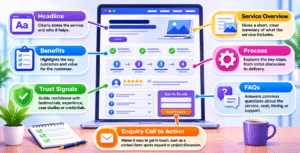
Start with a clear, customer-focused headline
Tell visitors exactly what service the page covers and who it helps. Avoid vague phrases that sound impressive but do not explain the offer.
Follow the headline with a short introduction describing the problem you solve and the outcome customers can expect. Visitors should quickly understand that they are in the right place.
Explain what the service includes
Outline the main tasks, deliverables or stages so visitors know what they are considering. For example, a website maintenance page might cover updates, backups, security checks, performance monitoring and support.
If you offer different packages, explain the differences clearly. Use short paragraphs and bullet points to make the details easy to scan.
Show who the service is for
Help readers recognise themselves in the page. Describe the customers who may benefit, the situations they face and the signs that your service could be useful.
Focus on real concerns rather than broad claims. A small business might need more enquiries, while a growing organisation may need a website that supports more complex processes.
When planning website design services Somerton, make sure each page speaks to its intended audience rather than repeating the same generic description across every service.
Explain your process and what happens next
Uncertainty can stop someone from enquiring. Explain what happens after a visitor contacts you, what information you may need and what the next steps look like.
A simple process might include an initial discussion, understanding requirements, preparing a proposal and agreeing on the project scope. Clarify what is included, what may cost extra and whether ongoing support is available.
Build trust with relevant evidence
Visitors need reasons to believe your business can deliver. Add proof where you have permission and accurate information to share, such as:
Genuine customer testimonials, used with permission.
Examples of completed work relevant to the service.
Verifiable qualifications, certifications or experience.
A clear explanation of your support and communication approach.
Answers to common concerns about cost, timing or requirements.
Avoid invented reviews, exaggerated results or guarantees you cannot substantiate. Specific, credible details are more persuasive than unsupported claims.
Make the page easy to scan and use
Use descriptive subheadings, concise paragraphs, meaningful images and lists where they clarify details. Avoid presenting important information as a wall of text.
The page should work well on mobile devices. Check that text is readable, buttons are easy to tap, forms fit the screen and important information is easy to find.
When assessing web design and development Somerton, consider how page structure, mobile usability and content work together. Visual design should support understanding, not distract from the service.
Give visitors a clear way to enquire
Make contacting your business straightforward. Include a clear call to action near the beginning and repeat it after the key information, where it feels natural.
Use action-focused wording such as “Discuss your project” or “Request an estimate”. Link it to a contact form, phone number or another channel your business actively monitors.
Keep forms focused. Ask only for details needed to start a useful conversation, such as a name, contact method and a short description of the requirement. Too many fields can discourage completion.
Review performance and improve the page
After publishing, review whether the page attracts relevant visitors and encourages meaningful enquiries. Look at form submissions, calls and questions customers still ask before making contact.
If visitors arrive but do not enquire, check whether the page explains the offer, answers common concerns and provides a visible next step. Test one improvement at a time.
A considered website design services Somerton approach includes reviewing page content and usability after launch, not just making it look polished on publication day.
For web design and development Somerton, ask how the team will assess page performance and recommend improvements as your services or customer needs change.
Conclusion
An effective service page combines clear messaging, useful detail, credible trust signals and an easy enquiry path. It helps visitors understand what you do, whether the service suits their needs and how to take the next step.
If your service pages are not generating the conversations you expect, NexIT Solutions can help review the content, structure and user experience. Build each page around the questions customers need answered, then keep improving it as you learn what visitors respond to.
Talk to a NexIT Expert
New Enquiries: 1300 899 259 | Support Team: [email protected]
REQUEST A FREE CONSULTATION