


If your business website feels outdated, loads slowly or no longer supports the way you work, it may be time for a change. But should you refresh the existing website or start again with a complete rebuild?
The two options can improve your online presence, but they solve different problems. A redesign focuses mainly on improving the website’s appearance and user experience. A rebuild goes deeper, replacing or restructuring the underlying technology, code or content management system.
Choosing the right approach can help you avoid unnecessary costs, reduce disruption and create a website that supports your business goals.
What is the difference between a redesign and a rebuild?
A website redesign usually keeps much of the existing technical foundation while improving its visual presentation, page layouts, navigation and content structure.
For example, you might update your colours, typography, images and mobile layouts while keeping the current platform and important functionality.
A website rebuild involves more substantial changes. It may include replacing the content management system, restructuring the website, rewriting code or developing new functionality.
A redesign changes how the website looks and feels. A rebuild changes how much of the website is put together. Some projects need both.
When is a website redesign enough?
A redesign may be the right option when your existing website works properly but no longer reflects your brand or meets visitors’ expectations.
Look for signs such as:
An outdated appearance: Your website looks inconsistent with your current branding.
Poor navigation: Visitors struggle to find services, contact details or important information.
Weak mobile experience: Pages are difficult to read or use on smaller screens.
Unclear content: Your services, benefits and calls to action are not communicated effectively.
Inconsistent page layouts: Different sections feel disconnected or difficult to navigate.
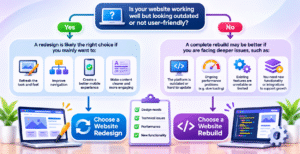
If the underlying platform is stable and the existing features still meet your needs, a focused redesign may deliver the improvements you want without replacing everything.
When considering website design services Somerton, explain which parts of your current website are working and which need improvement. This helps establish whether a visual and structural refresh is sufficient.
When does a complete rebuild make more sense?
Sometimes a fresh design cannot fix deeper technical problems. If the website is difficult to maintain, relies on outdated technology or cannot support the functionality your business needs, a rebuild may be more practical.
Consider rebuilding when:
The platform is difficult to update: Even small changes require technical work or create errors.
Important features no longer work: Existing forms, integrations or other functions are unreliable.
Performance problems persist: The website remains slow despite reasonable optimisation efforts.
Security and compatibility concerns exist: Older software or unsupported components create maintenance risks.
Your business requirements have changed: You need new workflows, customer accounts or integrations that the current setup cannot handle effectively.
A rebuild gives the development team an opportunity to review the structure and technology rather than working around every existing limitation.
For businesses exploring web design and development Somerton, the decision should be based on the website’s actual technical condition and future requirements, not simply its age.
Compare cost, time and business disruption
A redesign is often less involved because it may reuse the existing platform, content and functionality. A rebuild generally requires more planning, development and testing.
However, the cheaper initial option is not always the better long-term investment. A redesign that leaves major technical problems unresolved may lead to further work later.
| Consideration | Website redesign | Website rebuild |
|---|---|---|
| Main focus | Appearance and user experience | Structure, technology and functionality |
| Existing platform | Usually retained | May be replaced |
| Development effort | Often more limited | Usually more extensive |
| Project timeframe | May be shorter | Depends on complexity |
| Main benefit | Refreshes the existing experience | Addresses deeper limitations |
| Potential challenge | Existing technical issues may remain | More planning and testing required |
Before choosing, ask for a clear breakdown of the work involved. Compare what each option will improve, what it will leave unchanged and what ongoing maintenance may cost.
How can you decide which option your business needs?
Start with the problems you want to solve rather than deciding on a redesign or rebuild immediately.
Ask yourself these questions:
Does the current website function reliably? If the main features work, a redesign may be enough.
Can the platform support future changes? If it cannot accommodate essential requirements, consider a rebuild.
Are visitors struggling with the experience? Navigation, content and mobile usability issues may be addressed through a redesign.
Are technical limitations affecting the business? Persistent performance, security or integration problems may require deeper work.
What is the realistic long-term cost? Consider maintenance and future improvements, not only the initial project price.
When discussing website design services Somerton, ask for an assessment of your existing website before committing to a particular solution. A clear review can help identify which components should be retained, improved or replaced.
What should you plan before starting?
Once you understand the scope, prepare for the project carefully. Good planning helps prevent avoidable delays and protects important website information.
Review existing content: Identify pages to keep, update, combine or remove.
Check website performance: Review loading issues, broken features and mobile usability.
Protect SEO value: Plan redirects for changed URLs and preserve useful page content where appropriate.
Confirm functionality: List the forms, integrations and other features that must work after launch.
Set responsibilities: Decide who will provide content, review designs and approve changes.
Schedule testing: Allow time to check devices, browsers, forms and important user journeys.
A team providing web design and development Somerton should explain the project stages, expected deliverables, testing process and launch responsibilities before work begins.
Conclusion
A redesign is often suitable when your website works well but needs a better appearance and user experience. A rebuild is worth considering when deeper technical limitations prevent your website from meeting current or future business needs.
The best decision starts with understanding the problems, reviewing the existing setup and comparing the long-term value of each option. NexIT Solutions can help you assess your website and plan a practical approach for your Somerton business.
Talk to a NexIT Expert
New Enquiries: 1300 899 259 | Support Team: [email protected]
REQUEST A FREE CONSULTATION