
Pakenham has changed fast. What was once a country town on the edge of Melbourne is now one of the south-east’s major growth areas, with new homes, new retail and new industry arriving year after year.
For local businesses, that growth is good news and a challenge at the same time. More customers mean more enquiries, more jobs, more stock and more paperwork. A process that worked when you had five staff and a handful of clients can start to strain at twenty staff and a hundred clients.
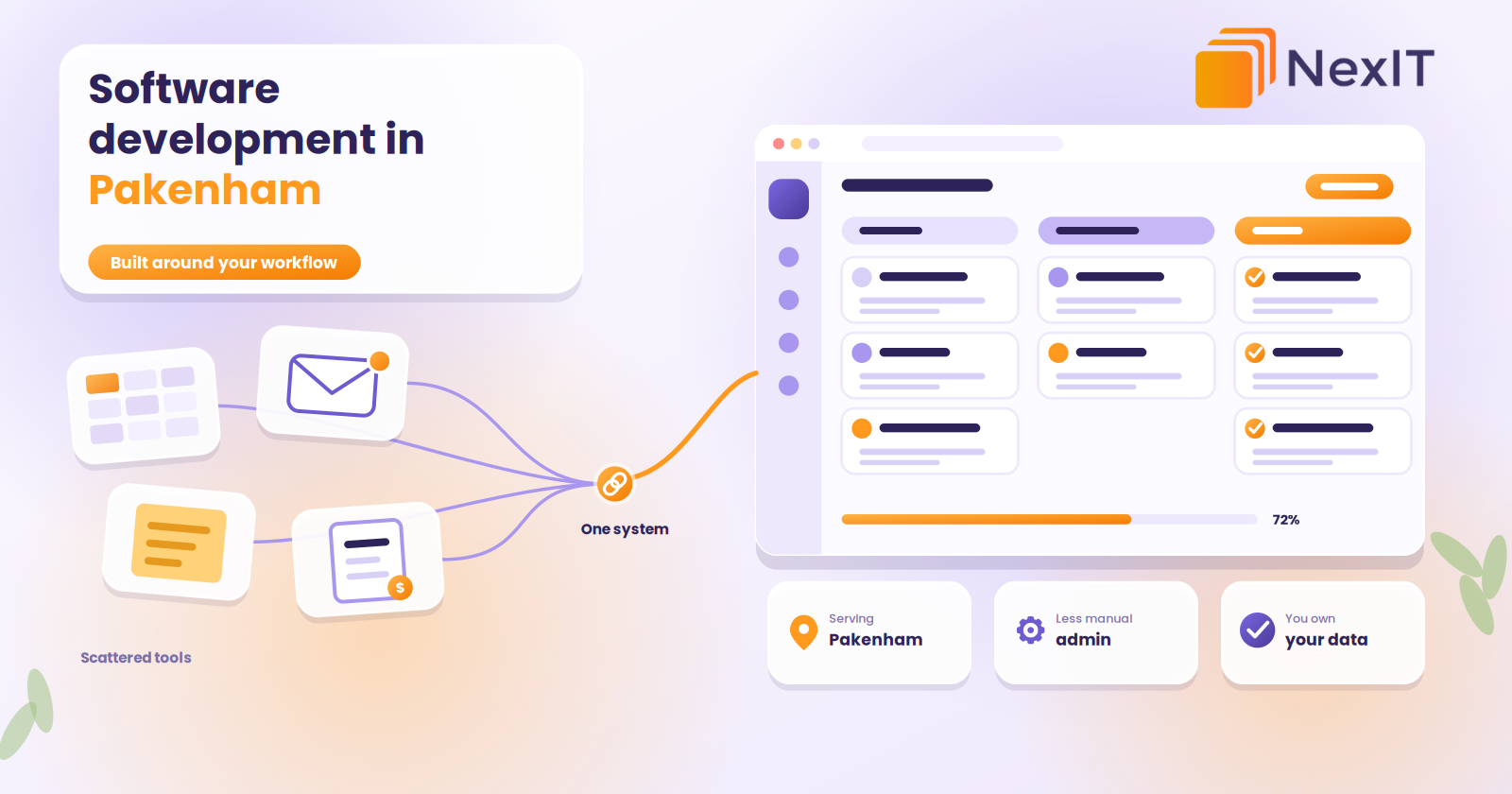
That’s usually when software development in Pakenham becomes a practical question, not a technical one: how do we stop running the business on spreadsheets, sticky notes and memory?
Here’s a plain-language guide to when custom software makes sense, what to build first and how to choose the right partner.
Why Pakenham businesses are looking at custom software
A few things are pushing local businesses in this direction.
Growth is putting pressure on old systems. Cardinia Shire is planning large employment precincts, including the Pakenham South and Cardinia Road areas, aimed at manufacturing, logistics, advanced engineering, technology and warehousing. As more businesses set up and expand nearby, competition for customers and skilled staff increases.
Small teams need to do more. Many Pakenham businesses are lean. Automating repetitive work lets a small team handle more without adding headcount.
Customers expect speed. People are used to booking, paying and tracking jobs online. If your process still relies on phone calls and manual follow-ups, a competitor with a smoother system has the advantage.
Off-the-shelf tools only go so far. Generic software is fine for standard needs. But if your workflow is unusual, you end up paying for features you don’t use and building workarounds for the ones you need.
Signs it’s time to consider custom software
You don’t need a custom system for every problem. But these are common signals:
- The same information gets typed into more than one place
- Your team spends hours each week chasing updates, quotes or approvals
- You rely on one person’s memory or one spreadsheet that nobody else dares to touch
- Reporting takes an afternoon instead of a few clicks
- Your current software doesn’t fit the way you actually work
- You’re paying for several tools that don’t talk to each other
- Customers keep asking for things you can’t offer because your systems can’t handle them
If three or more of these sound familiar, it’s worth a conversation.
What kinds of software do local businesses build?
Custom software development in Pakenham usually falls into a few practical categories.
Internal business systems. Job tracking, scheduling, quoting, stock management and reporting, built around your workflow. These often replace a tangle of spreadsheets.
Customer portals. A secure area where customers log in to view orders, invoices, documents or job progress, which cuts down on phone calls and emails.
Booking and scheduling systems. Online booking with reminders, staff calendars and payments, useful for service businesses, clinics and trades.
Field service and mobile apps. Tools for crews working on site, covering job sheets, photos, signatures, safety checks and timesheets, even with patchy reception.
Inventory and warehouse tools. Stock tracking, ordering and dispatch for suppliers, wholesalers and logistics businesses.
Integrations and automation. Connecting your accounting software, CRM, website and email so information flows automatically and nobody re-keys data.
Who benefits most in Pakenham?
Trades and construction. With so much building activity in the area, trade businesses juggle quotes, variations, subcontractors and compliance. A good job-management system saves hours and reduces mistakes.
Manufacturing, logistics and warehousing. As industrial areas grow, businesses need accurate stock, order and dispatch systems that scale with volume.
Health and professional services. Booking, client records and secure communication, handled with proper privacy controls.
Retail and local services. Online ordering, loyalty, scheduling and customer accounts that bring people back.
Property, real estate and home services. Inspection reports, maintenance requests, tenant and owner portals and automated follow-ups.
Rural and agricultural suppliers. With farmland close by, local suppliers often need ordering, delivery and inventory tools that suit their customers’ way of working.
Where to start: don’t build everything at once
The biggest mistake with software projects is trying to build the dream system in one go. A better approach:
- Pick the biggest time-waster. What process costs you the most hours or causes the most errors?
- Map how it works today. Who does what, in what order, with which tools?
- Build a focused first version. Solve that one problem well.
- Let your team use it. Real feedback beats assumptions.
- Expand step by step. Add features based on what people actually need.
This keeps costs under control and lowers the risk of building something nobody uses. If you’d like a deeper breakdown, our guide to custom software development costs in Melbourne explains what drives the price.
Talk to a NexIT Expert
New Enquiries: 1300 899 259 | Support Team: [email protected]
REQUEST A FREE CONSULTATION
What does it cost, and how long does it take?
There’s no single answer, but the factors are consistent:
- The number and complexity of features
- How many types of users the system has
- Integrations with tools you already use
- How much custom design is involved
- Data migration from existing systems
- Security and compliance requirements
- Ongoing support after launch
A focused tool that replaces a few spreadsheets can often be built in a few months. Larger platforms with several user roles and integrations take longer. A clear brief and quick feedback from your side are the best ways to keep a project on schedule.
Ask for an itemised quote, and check what’s included after launch. Hosting, maintenance and updates are real costs, and they should be part of the conversation from the start.
Local team or remote team?
A software company in Pakenham, or one that works closely with Pakenham businesses, offers practical advantages:
- Meetings in person when they matter, especially at the start
- A team that understands local business conditions and Australian privacy requirements
- The same time zone for fast support
- Easier on-site observation of how your business actually runs
That doesn’t mean remote or offshore work is always wrong. It does mean you should ask who is building your software, where they’re based and how communication will work.
Red flags
- A quote with a single number and no breakdown
- No discovery or planning stage
- Pressure to sign quickly
- Vague answers about who does the work
- Contracts that keep ownership of the code
- No support plan after launch
Common mistakes to avoid
- Starting with technology instead of the problem. Software should follow your process, not the other way round.
- Adding features “just in case”. Every extra feature adds cost and complexity.
- Skipping the training. Even great software fails if your team isn’t confident using it.
- Ignoring data migration. Moving existing information takes planning.
- Treating launch as the finish line. The best systems keep improving.
- Choosing on price alone. A cheap build that needs rebuilding costs more in the end.
Talk to NexIT Solutions
What does a software development company in Pakenham do?
It plans, designs, builds, tests and supports software for your business. That might be an internal system, a customer portal, a booking platform, a mobile app or integrations between tools you already use. A good company also helps you decide what to build first and what you don’t need.
How much does custom software development cost in Pakenham?
It depends on the number of features, user roles, integrations, design and security requirements. A focused internal tool costs far less than a full customer platform. The most reliable way to get a real figure is to describe your problem to a few developers and compare itemised quotes.
How long does it take to build custom software?
A simple, focused system can take a few months. Larger platforms with integrations and multiple user types take longer. Launching a first version quickly, then expanding, is usually the fastest route to something useful.
Is custom software better than off-the-shelf software for a small business?
Not always. Off-the-shelf software is often the right choice for standard needs like accounting or email. Custom software makes sense when your processes are unique, your tools don’t connect or manual work is costing you significant time. A good developer will tell you honestly which applies to you.
Do I need a technical background to work with a software developer?
No. You know your business, and a good developer handles the technical side. Start by explaining what takes too long, what goes wrong and what you want to improve. The developer’s job is to turn that into a clear plan.
Not sure which is right for your business?
The best choice depends on what your website needs to do for you, and a short conversation usually makes it clear. NexIT Solutions helps Melbourne businesses plan, design and build websites on WordPress, custom platforms and everything in between, and we’ll tell you honestly which one fits.
📞 Call NexIT Solutions today: 1300 899 259