
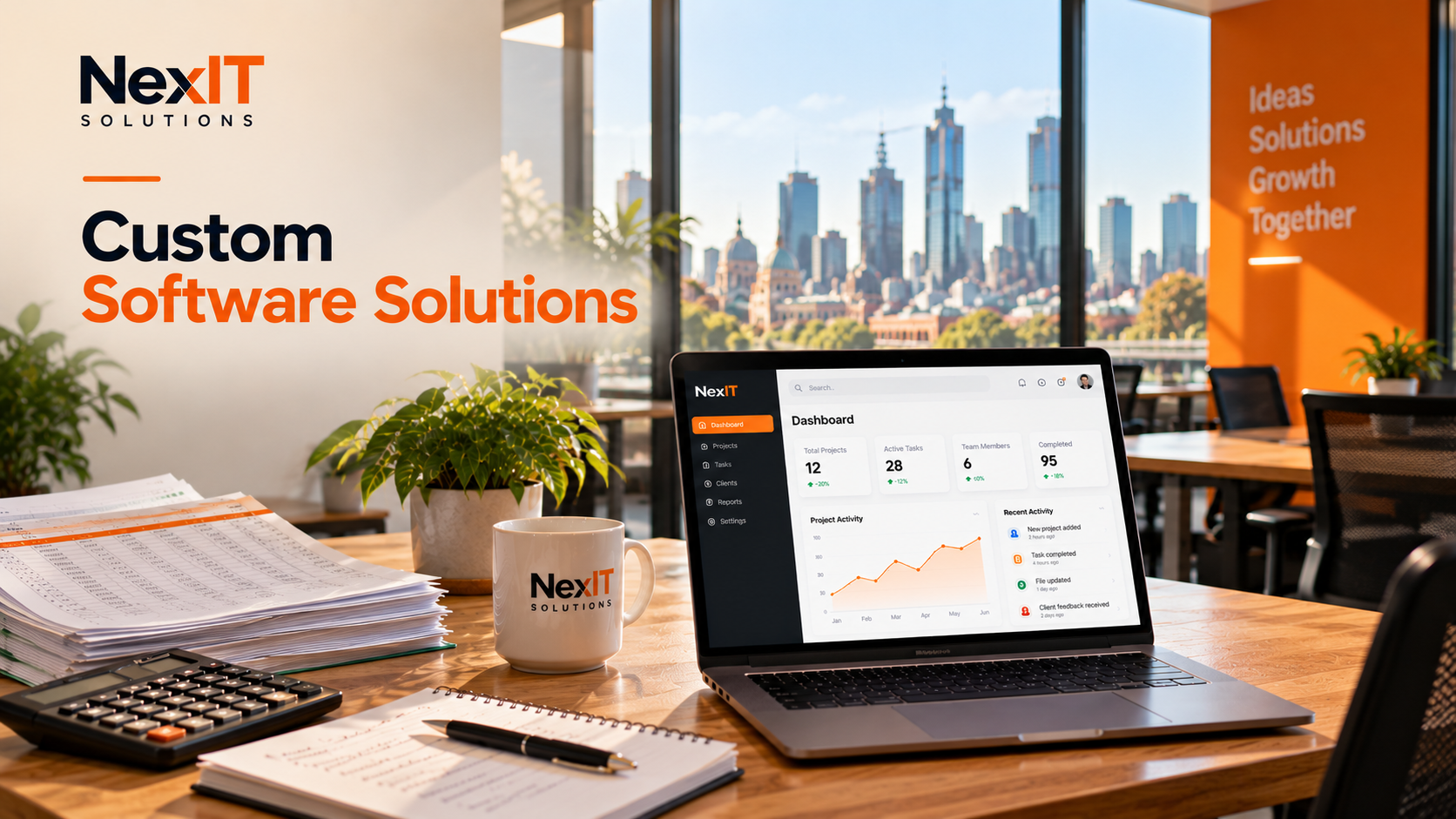
From Spreadsheets to Software: Custom Software Solutions In Melbourne
Most businesses don’t start with custom software.
They start with a spreadsheet.
One file for customers. Another for jobs. Another for stock, quotes, schedules, or reporting. It works well enough at first, so there is no real reason to change it.
Then the business grows.
More people need access. More information needs to be updated. More processes depend on someone remembering what to do next. Before long, the spreadsheet that once saved time starts taking it away.
That was the kind of problem we were solving on a software development project.
The business didn’t want a complicated system with hundreds of features. They wanted something much simpler: a better way to run the work they were already doing.
The problem wasn’t the spreadsheet.
The spreadsheet itself wasn’t broken.
The process around it was.
Information was being entered in more than one place. Team members had to check different files to find the latest details. Some tasks depended on manual follow-ups, while others relied on someone remembering the next step.
It also made reporting harder.
When information is spread across several files, even a simple question can take time to answer:
What is happening right now?
What still needs to be done?
Who is responsible for it?
Which information is up to date?
Those questions shouldn’t require opening six spreadsheets. Why Invest?
We started with the workflow, not the software
The easy way to approach a project like this is to start talking about technology.
Which platform should we use?
What database do we need?
Should it be a web application?
What framework will the developers use?
Those questions matter later.
First, we needed to understand how the business actually worked.
We looked at the daily process from the team’s point of view:
Where does the information start?
Who uses it?
What gets entered manually?
Where does the process slow down?
Which steps are repeated?
What information needs to be visible to different people?
Once those questions were answered, the software requirements became much easier to define.
We turned separate tasks into one connected process
The goal wasn’t to replace every spreadsheet with software.
It was to replace the parts that had become difficult to manage.
The information the business used most often was brought into one structured system. Instead of maintaining separate files, the team could work from a single source of information.
Instead of manually checking which stage a job was at, the workflow could show it clearly.
Instead of copying information from one document to another, the system could connect the relevant steps.
That sounds straightforward.
Building it properly isn’t.
The software still needed to feel simple to the people using it every day.
We focused on the work people actually do
One of the easiest mistakes in software development is adding features because they sound useful.
A dashboard can always have another chart.
A system can always have another report.
A platform can always have another setting.
But more features do not automatically mean better software.
We focused on the tasks that were costing the business the most time and created a system around those needs.
The team shouldn’t need a manual just to complete a routine task.
If something can be done in three steps instead of ten, that’s a meaningful improvement.
If information can be entered once instead of three times, that’s a meaningful improvement.
If everyone can see the same information without checking different files, that’s a meaningful improvement.
The software doesn’t need to look complicated to be powerful.
It just needs to make the work easier.
Is your business still relying on spreadsheets?
Spreadsheets are useful, but they can become difficult to manage when your business grows.
If your team is spending too much time updating files, copying information between systems, or manually tracking everyday processes, it may be worth looking at what could be automated.
NexIT can help you understand where the real bottlenecks are before recommending a solution.
Talk to NexIT About Your Workflow →
Tell us what your team is doing manually today, and we can help you work out what could be simplified, connected, or automated.
Custom software isn’t always the answer.
This is important.
We don’t believe every business needs custom software.
Sometimes an existing platform is good enough. Sometimes a small integration can solve the problem. Sometimes a redesign of the current workflow is all that’s needed.
Custom development starts to make more sense when:
- Your current software doesn’t fit the way your team works
- The same information is entered into multiple systems
- Manual administration is taking too much time
- Your processes are becoming more complicated
- You need several systems to work together
- Your business requires functionality that standard software doesn’t offer
- You need a platform that can grow with changing requirements
The question isn’t really:
“Can we build this?”
Of course we can explore that.
The better question is:
“Will building this make the business work better?”
That is the question we try to answer first.
From a spreadsheet problem to a software solution
The biggest change isn’t always something you can see on screen.
It’s what happens behind the scenes.
A better system can mean fewer repetitive tasks, clearer workflows, less time spent searching for information, and a more consistent way for the team to work.
It can also give the business a much better foundation for growth.
A spreadsheet may be enough when there are five people and a small number of records.
It can become much harder to manage when the team, customers, and daily activity grow.
That’s usually when businesses start looking for something more reliable.
What makes a software project successful?
It isn’t just good code.
A successful software project starts with a clear understanding of the business problem.
It needs:
A Clear Purpose
Everyone should understand what the software is actually supposed to improve.
A Practical User Experience
The people using the system every day should find it straightforward.
The Right Features
Build what the business needs first. Additional functionality can come later.
Good Integration
If the business already uses other systems, the new software should work with them where appropriate.
Room to Grow
The solution should be able to evolve as the business changes.
Ongoing Support
Software is not finished just because it has launched. Updates, improvements and maintenance still matter.
The same thinking applies to larger software projects
The move from spreadsheets to software is only one example.
Businesses also come to us when they need:
- Custom CRM systems
- ERP and business management platforms
- Customer portals
- Booking and scheduling systems
- Inventory management tools
- Workflow automation
- SaaS products
- API and system integrations
- Internal business applications
The technology may change from project to project.
The process doesn’t.
Understand the problem. Simplify the workflow. Build around the users.
That’s the part that matters.
What we learned from the project
The lesson wasn’t that spreadsheets are bad.
They aren’t.
For many businesses, spreadsheets are exactly the right starting point.
The problem begins when the business outgrows the way information is being managed, but the process stays the same.
That’s when small inefficiencies start adding up.
A few minutes here.
A repeated task there.
A report that takes an afternoon instead of half an hour.
None of those things sounds dramatic on its own.
Together, they can become a genuine business problem.
Good software removes that friction.
It gives people a clearer way to work and gives the business a better platform to build on.
Thinking about custom software for your business?
If your team is spending too much time working around spreadsheets, disconnected systems or repetitive processes, it may be time to look at a better approach.
NexIT Solutions provides custom software development in Melbourne and Moorabbin, helping businesses plan, design and build software around the way they actually work.
You don’t need to arrive with a complete technical specification.
Start with the problem.
Tell us what is taking too long, what is difficult to manage, or what you want to improve.
Ready to Work Smarter?
📞 Call NexIT Solutions: 1300 899 259
💻 Discuss Your Software Project →
Let’s look at the process first, then work out what the technology should do.